Progressive Economics

Subprime Mortgages, The Crisis of Capital, and Social Justice

The causes of the mortgage fiasco beginning in 2007 which led to the financial meltdown are admittedly complex. Predatory lending played a significant part, but what was more troubling was the ability of financial institutions to inflate the value of debt that was never really meant to be paid back through various financial tools. Surely, the predatory lenders were acting in their own short-term self-interests. For creating a mortgage you get a commission. As far as the individual lenders can see there was only motivation to increase home sales and mortgages. What is interesting to wonder, though, is whether the “higher level” institution — those buying, repackaging, and reselling the debt in order to make a profit — were able to foresee the effects of what they were doing.

Marx predicted that as capitalism advanced people would begin to see the economic relations that they personally entered into as being for the purposes of making money rather than for being for the purposes of making a good. Money is supposed to be, in capitalism, the symbolic form of use-value. It is the symbolic dimension wherein the strength of both an economy and an individual to produce useful things is expressed. Banking is an industry which profits by mediating exchanges – it itself is much like money in this regard, its purpose is to mediate exchanges. What is the same with regard to a package of debt (interest bearing capital) and money is that neither is actually useful in the same sense a shovel or a coat is useful. That is, a shovel and a coat have a practical use, money does not have a practical use except to be exchanged for things that do have a practical use.

Marx also predicted that interest bearing capital would be treated as something which had an objective power to create value for the owner of that capital, which it does, but that value is purely symbolic, it is monetary but does not reflect a use-value. It, like money, doesn’t reflect any particular content. A symbolic value which does not reflect a real value might be thought of as, in modern terms, a “bubble.”

Continue Reading This Article…

{ 3 comments }

The Cost Of Being Poor In America

by Progressive Economics on May 2, 2011 |   Trackback URI   |     Email This Post Email This Post   |   8437 Views  

The Cost Of Being Poor In America Infograph

Continue Reading This Article…

{ 8 comments }

Goldman Sachs - The Giant Vampire Squid

I’ll keep it short but sweet: Matt Taibbi, author of the infamous Goldman Sachs – Vampire Squid article, is out with a new book entitled Griftopia: Bubble Machines, Vampire Squids, and the Long Con That Is Breaking America . As described, this book is “essential reading for anyone who wants to understand the labyrinthine inner workings of politics and finance in this country, and the profound consequences for us all.” It’s a must read for those interested in how and why the American government has been hijacked by Wall Street.


{ 2 comments }

The Growth Of American National Debt

by Progressive Economics on June 11, 2010 |   Trackback URI   |     Email This Post Email This Post   |   1626 Views  

Chart Graph Of National Debt In America

debt as percent of gdp The Growth Of American National Debt

As of June 1, 2010, the Total Public Debt Outstanding was approximately 88.9% of GDP, and for the first time exceeded $13 trillion. Yes, you read that right: the national debt for the United States is now 90% of the total economic output for a year.
Continue Reading This Article…

{ 1 comment }

All You Need To Know About The Global Economy

by Progressive Economics on January 25, 2010 |   Trackback URI   |     Email This Post Email This Post   |   108 Views  

This is about all you need to know about the global economy and the structure of capitalism:

Bonuses paid out to Goldman Sachs executives in 2009: 20 Billion Dollars

Total Gross Domestic Product (GDP) of Haiti: 7 Billion Dollars

That’s $20 billion for a thousand Wall Street investors and $7 billion for 10 million Haitians. The average Haitian makes 700 dollars, the average Goldman Sachs executive makes 20 million dollars in bonuses alone, not including salary. Profound differences like these are the rule rather than the exception in global capitalism, demanding the continuous upward distribution of resources away from developing countries. The perpetuation of gross economic and political inequalities is crucial to the excess created for the financial elite in the West.

See Also: The best way nobody’s talking about to help Haitians, Haiti rescue effort winds down, tens of thousands left homeless, Faces Of Haiti, Haiti awash in doctors; nurses in short supply, Have we got contact?, The Decade to Come, The Earthquake in Haiti: Another Way to Help, 13 Bankers, “A Modest Proposal” to Reform How Bank Executives are Paid, Wall Street Compensation 2006-09, The Games of the Financiers, Fixing U.S. Democracy to Give Economy a Chance, Resetting the Moral Compass, and “Laissez-Welfare and the Goldman Gang”.

Technorati Tags: haiti, goldman sachs, global inequality, global capitalism, goldman sachs bonuses, economy of haiti, total gdp of haiti, economic inequality, bonuses, goldman sachs executives, financial elite, wall street, systemic inequality, poverty, development, haitian economy, gross domestic product of haiti, aid, foreign aid,

{ 0 comments }

Unemployment Rates By State In The U.S.

by Progressive Economics on October 22, 2009 |   Trackback URI   |     Email This Post Email This Post   |   880 Views  

Jobless recovery, in case you were wondering, is a tidy euphemism for “the rich are fine now, but you sure as hell aren’t”:

 Unemployment Rates By State In The U.S.

From the Wall Street Journal:

The jobless rate was flat or declined in 27 states [in September]. Michigan still has the highest unemployment rate by far at 15.3%, as the state continues to suffer along with American auto manufacturers. Housing bubble hot zones Nevada, California and Florida still have rates over 10%, though California’s rate dropped a bit from August. North and South Dakota have the lowest jobless rates. Fifteen states and the District of Columbia have unemployment rates higher than the national average of 9.8%.

See Also: Parsing Unemployment, The Unplanned Stimulus, California: Fading Lodestar, Weekly Unemployment Claims Increase, States Report Widespread Job Losses in September, Two Nations, “The Growing Case for a Jobless Recovery”, A New Civil Rights Movement is Afoot for the Middle Class, Unemployment: Great Depression vs Great Recession, and the growing case for a jobless recovery.

Technorati Tags: state by state unemployment, unemployment rates, state unemployment rates, individual states, united states of america, american unemployment, pictures, graphs, map, map of unemployment in america, u.s. employment

{ 0 comments }

Economic Inequality In The United States

by Progressive Economics on July 26, 2009 |   Trackback URI   |     Email This Post Email This Post   |   1420 Views  

economic inequality in the united states Economic Inequality In The United States

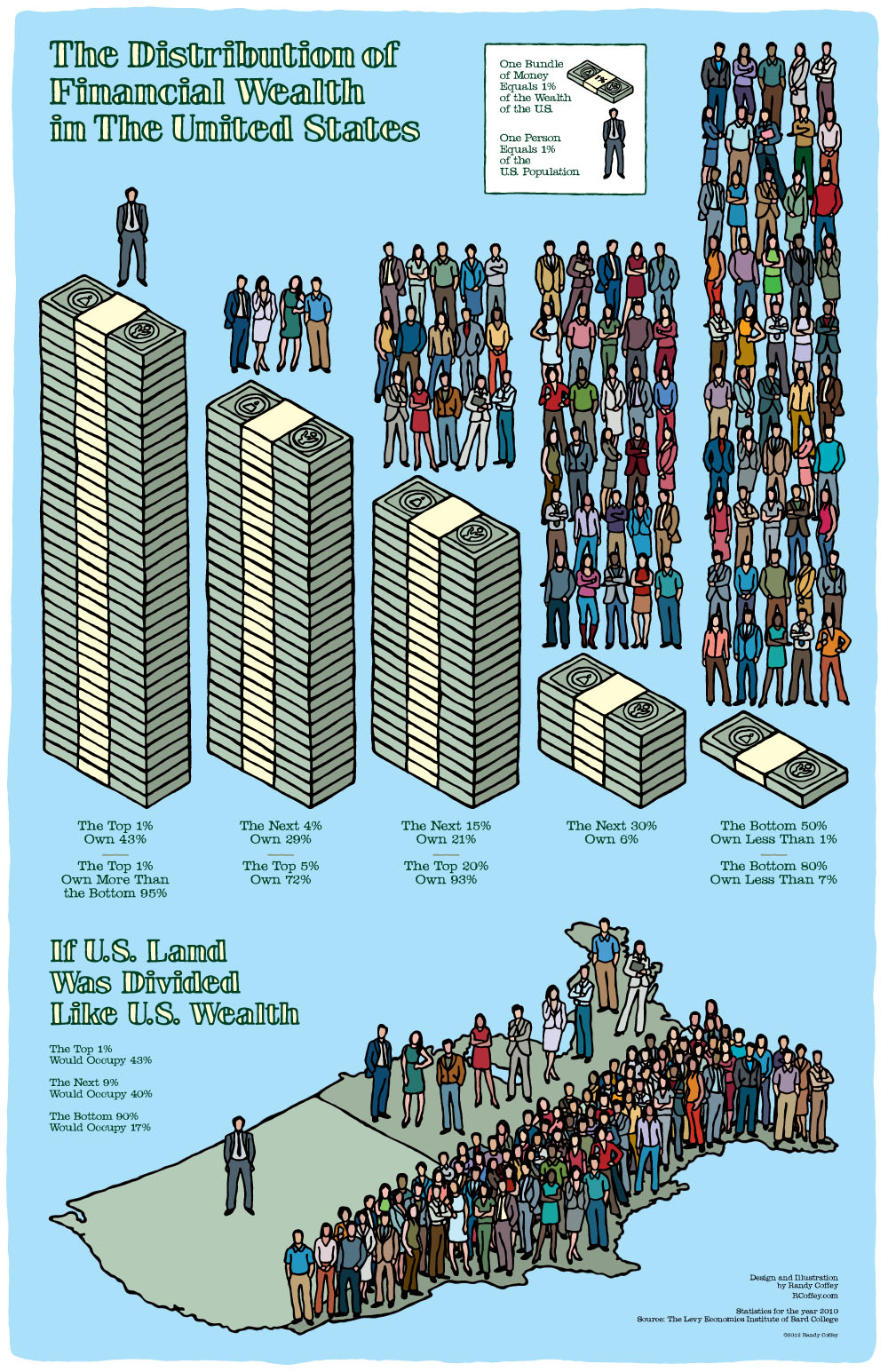
From jmooneyham.com, this image represents how much cash separates the top 1% from the bottom 99% of the population in the United States. It gets worse:

During eight years of the Bush administration, the 400 richest Americans, who now own more than the bottom 150 million Americans, increased their net worth by $700 billion. In 2005, the top 1 percent claimed 22 percent of the national income, while the top 10 percent took half of the total income, the largest share since 1928….

The highest incomes come from executive pay at top corporations. In 2007, the ratio of CEO pay to the average paycheck was 344 to 1, lower than the record 525 to 1 ratio set in 2001, but substantial. [via Common Dreams]

Technorati Tags: economic inequality in the united states, income inequality in the united states, top 1%, top 10%, bottom 99%, bottom 90%, graphs on income inequality, graphs on inequality, share of american income, numbers, statistics, america, united states of america, poverty, poor, rich

{ 4 comments }

With the current economic climate, there has been much discussion about the origins of the financial crisis and the future of capitalism. In these typically hollow debates, Adam Smith is routinely and thoughtlessly invoked as the founder of modern capitalist though, based on unrestrained trade, limited government, and the mechanics of market economies. To this day, The Wealth of Nations is held up as the espousal tome for free-market ideology that decries government regulation, excessive taxation, and wealth redistribution (in whatever contrived shapes it may take).

But the myth of Adam Smith created by two centuries of advanced industrialization and capitalism is very far from the reality of Adam Smith. The majority of academics and pundits alike generalize on Smith’s observations about the invisible hand, the benefits of division of labor, and the growth of wealth through free trade.

Outside of these points, The Wealth of Nations serves as an of his time reaction to the impact of corporations and mercantile interests on economies and governments. More specifically, Smith spent much of his book reacting to the growth of the East India Company, whose stockholders were to be found on every level of government decision making in Great Britain and thought to be adversely effecting foreign policy and internal financial systems. Smith was also appalled at the exploitation under the reign of the East India Company, including the starvation of over 30 million people in modern-day Bangladesh due to British-imposed tariffs.

As Chomsky notes, Smith saw the East India Company and other stockholding corporations as bending state policy towards the good of the few at the expense of the many. Smith to this end was in favor of heavy-handed government regulation to prevent financial and corporate powers from manipulating government policy for their own ends. This led him to conclude on the nefarious impulse of corporate manipulation, that when “People of the same trade seldom meet together, even for merriment and diversion, but the conversation ends in a conspiracy against the public, or in some contrivance to raise prices. It is impossible indeed to prevent such meetings, by any law which either could be executed, or would be consistent with liberty and justice. But though the law cannot hinder people of the same trade from sometimes assembling together, it ought to do nothing to facilitate such assemblies; much less to render them necessary.”

The legacy of Smith continues to diverge further and further from the reality of Smiths principles which were heavily influenced by Rousseau and other humanist figures of the Enlightenment. Smith advocated for a system of progressive taxation and a political economy centered on the freedom of creative pursuits but protective of the working class. Considering how his legacy is enshrined today, it seems out of place to realize that Smith’s chief concern was for economic policy to be secondary to moral and ethical concerns such as economic equality, freedom of speech, and dignified and just labor conditions.

See Also: Was Adam Smith a liberal?, Justin Fox’s new book: ‘Myth of the Rational Market’, “The Hottest Places in Hell are Reserved for Those Who, in Times of Moral Crisis, Maintain a Neutrality”, How the financial crisis has killed the governance reform agenda, A Fleecing Of The Sheeple, Another Comment on Bonuses and Benchmarks, Taking Stock: Economy and Government, and Now Lemme Tell You A Story, The Devil He Has a Plan.

Technorati Tags: adam smith, the wealth of nations, free markets, economics, capitalism, taxation, government regulation, evaluating smith’s legacy, what adam smith really believed, political economy, corporate influence, government

{ 17 comments }

Page 2 of 41234