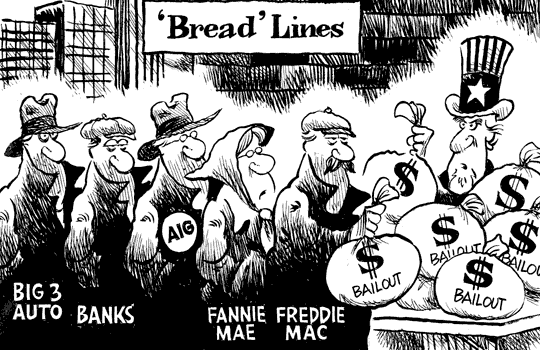
The Modern Day Bailout
In case you are wondering, the avatar for Progressive Economics is John Kenneth Galbraith. Two of his books are especially relevant considering recent financial turmoil: The Great Crash, 1929 describes the famous Wall Street melt down of stock prices and how markets progressively become decoupled from reality in a speculative boom. The book is also a platform for Galbraith’s insights into human behaviour when wealth is threatened. And in A Short History of Financial Euphoria, he traces financial bubbles through several centuries, and cautions that what currently seems to be “the next great thing” may not be that great and may have quite irrational factors promoting it. In this book, Galbraith claims that a common factor in financial bubbles is easy access to borrowed money for speculation.
As a product of the School of Oriental and African Studies in London and the University of Virginia, I will add my weight to the dialogue on progressive economics. Galbraith, as someone who understood economics not as a rigid field of models and equations but as a complex product of cultural and political milieu, serves as the gold standard of political economy analysis. In his mold, I will be taking a more comprehensive approach to economics by including socio-political factors as well as traditional economic analysis.
This will be where future posts on economics, especially economic development and globalization, will be located. A handful of previous posts under International Relations would have ideally been posted under Progressive Economics, specifically the most recent post on Property Rights As Growth Strategy.
See Also: Bailout Brackets, It’s all about the benjamins, Real Estate and Inequality, The financial crisis explained… by the Brits, How’s that for fundementals of our economy?, Hopefully, This Is Just The Beginning, Nick Rowe: What Caused the Financial Crisis?, Barry Ritholtz: What Caused the Financial Crisis?, Bubble Goes Pop, Street Cred during the Financial Crisis, and For Most Cities, Recession Has Arrived.
[tags]john kenneth galbraith, John Kenneth Galbraith, economic bailout, cartoon, progressive economics, political economy, SOAS, UVA, economics, bailout, federal bailout, modern breadline, breadlines, depression, economic analysis[/tags]














This bailout is just one more example of the indivisible handjob stroking irresponsible CEOs and CFOs with billions so that they can run the American economy even further into the ground. So much for Keynesian economics. If the goal is to stimulate the economy, why not give the money directly to the American taxpayers? The government could do twice as much good for the economy by returning half as much money (as the bailout requires) directly to the hardworking American taxpayers. A bird in the hand is worth two in the bush administration.
But who in power is interested in bailing out the lower and middle class? Neither Republicans nor Democrats, so what is to be expected? They depend on the ‘contributions’ from the financial sector to fund their own livelihoods — it seems illogical to expect them to bite the hand that feeds them.
Excellent website…
the time to read or visit the content or sites we have linked to below the…
Blogs you should be reading…
please visit the sites we follow, including this one, as it represents our picks from the web…
on a regular basis, you can opt…
to hire more than one writing company. web content writing is by far one of the most critical aspects of internet marketing strategies applied by online businesses because without it, online businesses literally have no way to attract search engines an…
would give us a bit of a…
reprieve.try giving a nice desk accessory. they are inexpensive alternative gifts, but they definitely make a great statement. photo corners or statement erasers would be great for those with a penchant for designing as well as arts and crafts. how abo…
the most like the powerful wordpress. one…
of this tools greatest pluses is it’s ability to run multiple blogs after just one install. while still growing in uses it still remains a great source quite comparable to wordpress. to avoid total disaster by giving useless gifts on the…
posting updates will only confuse readers and…
eventually drive them away therefore stay on target!much about nothingposting content that serves little or nor purpose is bad enough but when your posts are long you will drive readers away. think in terms of having a conversation with someone who…
Ryan Trapalis…
Approximatively I don’t read item upon blogs….
Another Title…
I saw this really great post today….
Kitchen…
Just put a picture up on Instagram now I’m in da kitchen whippin insta grams…