Author Archive

Why It’s Time To Act In Libya

Revolution in Libya

The Article: Act. Now. The world must do more than watch the Libyan bloodletting. by Hussein Ibish in Foreign Policy.

The Text: The unfolding catastrophe in Libya has forced the world to once again grapple with the conundrum of international humanitarian intervention. However, recent efforts at intervention — notably the humiliating episode in Somalia and the terrible failure to act in Rwanda — have revealed both the risks of action and the costs of inaction.

Muammar al-Qaddafi’s bloodcurdling speech on Feb. 22 should force even skeptics of international intervention to think twice. In his defiant remarks, the Libyan dictator vowed to “cleanse Libya house by house” in order to stay in power. Qaddafi also insisted that he has not begun to crack down in earnest — despite sketchy reports that his effort to quell the protests has already left hundreds, possibly thousands, of unarmed people dead — and approvingly cited other uses of state security forces to quell unrest, such as the Chinese assault on Tiananmen Square and the U.S. actions in Waco and Fallujah.

Continue Reading

Email

Fur Coat Revolutionaries (How Humanitarian Assistance Isn’t Humanitarian)

The Article: Alms Dealers: Can you provide humanitarian aid without facilitating conflicts? by Philip Gourevitch, published in October by the New Yorker.

The Text: In Biafra in 1968, a generation of children was starving to death. This was a year after oil-rich Biafra had seceded from Nigeria, and, in return, Nigeria had attacked and laid siege to Biafra. Foreign correspondents in the blockaded enclave spotted the first signs of famine that spring, and by early summer there were reports that thousands of the youngest Biafrans were dying each day. Hardly anybody in the rest of the world paid attention until a reporter from the Sun, the London tabloid, visited Biafra with a photographer and encountered the wasting children: eerie, withered little wraiths. The paper ran the pictures alongside harrowing reportage for days on end. Soon, the story got picked up by newspapers all over the world. More photographers made their way to Biafra, and television crews, too. The civil war in Nigeria was the first African war to be televised. Suddenly, Biafra’s hunger was one of the defining stories of the age—the graphic suffering of innocents made an inescapable appeal to conscience—and the humanitarian-aid business as we know it today came into being.

Continue Reading

Email

Is Solitary Confinement A Form Of Torture?

The Article: Hellhole: The United States holds tens of thousands of inmates in long-term solitary confinement. Is this torture? by Atul Gawande in the New Yorker.

The Text: Human beings are social creatures. We are social not just in the trivial sense that we like company, and not just in the obvious sense that we each depend on others. We are social in a more elemental way: simply to exist as a normal human being requires interaction with other people.

Children provide the clearest demonstration of this fact, although it was slow to be accepted. Well into the nineteen-fifties, psychologists were encouraging parents to give children less attention and affection, in order to encourage independence. Then Harry Harlow, a professor of psychology at the University of Wisconsin at Madison, produced a series of influential studies involving baby rhesus monkeys.

Continue Reading

Email

Scales Of Terror: The Post 9/11 World

The Article: Global Executioner: Scales of Terror by Neil Smith, published by the Social Science Research Council.

The Text: The French philosopher Joseph de Maistre argued that insofar as human beings were constantly tempted to evil by their deepest passions, the maintenance of a peaceful social order ultimately depended on a single person, the executioner. It was much the same with nation states, according to Maistre, which “are born and die like individuals” and have a singular soul, a singular “race.” Reason was insufficient to combat passion, he believed, and the hiatus between them was inevitably colonized by power, whether between individuals or nations. The state takes on the role of executioner.

This conflation of scales – the assumption of a homology between individual and nation, a seamless continuity between individual and national behavior – Maistre shares with many Enlightenment and counter-Enlightenment thinkers alike, and it is foundational to the nation building project that accompanied the emergence of nation states in the eighteenth century. For want of a more sophisticated geography of global affairs, this ideological scale conflation retains a resonant appeal today in self-understandings of US foreign policy, whose justificatory discourse is full of recourse to nations as schoolyard bullies or “rogues.” It registers too in the defensive identification of individuals with government during times of conflict (“we should bomb Iraq”) in a country and a national culture that prides itself as anti-government.

Continue Reading

Email

Reevaluating The Chinese ‘Superpower’

Reevaluating China As A Superpower

The Article: The China Superpower Hoax by Steven Hill in TruthDig on September 23, 2010.

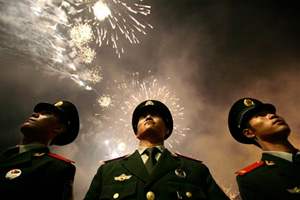
The Text: China must have the best public relations maestros in the world. How else would a country with a lower per capita income than Iran, Mexico and Kazakhstan, one of the worst environmental records of any major nation, endemic corruption, jails stuffed with dissenters, and a dictatorship, besides, be hailed by so many as the next global superpower?

Certainly China is big—1.3 billion people big, a fifth of the global population. As Forbes’ columnist John Lee has written, China has long been the place for the world’s biggest anything: the Great Wall, the 2008 Olympics, Tiananmen Square, the South China Mall in Dongguan, dams, consumption of cement and production of automobiles; most recently, China even had the world’s biggest traffic jam—an incredible 60 miles long—which lasted a month and during which drivers were stuck in their cars for days at a time.

Continue Reading

Email

Hot On The Web