Author Archive

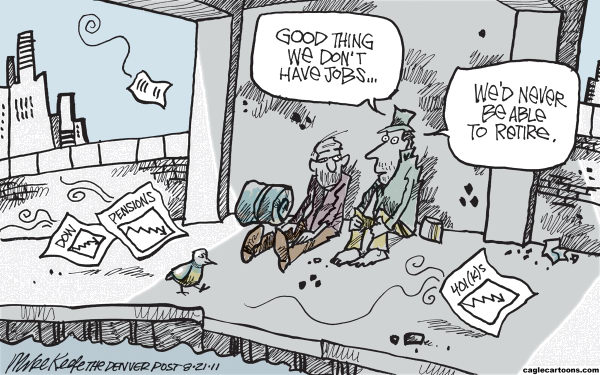
5 Ways We’re Being Violated By Big Business
Big Business Cartoon

The Article: Five Ways We’re Being Violated by Big Business by in The Contributor.

The Text: We already pay dearly for energy, medicine, banking, and telecommunications services. But a little research reveals that we’re paying more—much more—in a variety of ways that our business-friendly mainstream media won’t talk about.

1. Drug Companies: The Body Snatchers

A report by Battelle Memorial Institute determined that the $4 billion government-funded Human Genome Project (HGP) will generate economic activity of about $140 for every dollar spent. Although that estimate is controversial, drug industry executives say it’s just a matter of time before the profits roll in.

Big business is quickly making its move. Celera Genomics was first, as the company initiated a private version of the genome project, incorporating the public data into their work, but forbidding the public effort to use Celera data. Abbott Labs is developing products based on the HGP. Merck’s automated biotechnology facility was made possible by the HGP. Two-thirds of the products at Bristol-Myers Squibb have been impacted by the HGP. Pfizer is starting to make big profits from its genome-based cancer treatments.

Continue Reading

Email

Looking For Fraud? Look At Wall Street, Not Food Stamp Recipients

Food Stamps

The Article: Looking for fraud? Don’t look at food stamp recipients, look at Wall Street by Chris Arnade in The Guardian.

The Text: Hunger will drive kids to do crazy things. Like stay at school.

A few weeks ago South Bronx public schools had a half-day, with dismissal at noon. Yet almost all the kids stayed an extra hour, waiting in the cafeteria to eat the schools’ free lunch.

Teachers even got calls from parents of children who hadn’t stayed, asking them why they let their children leave without a meal. The teachers explained that this had never been an issue before. Kids had always left when they could. The parents responded, “That was before the cut in food stamps. We get $45 less a month now”.

Continue Reading

Email

Why We Should Raise The Minimum Wage Now

Money

The Article: Better Pay Now by Paul Krugman in The New York Times.

The Text: ’Tis the season to be jolly — or, at any rate, to spend a lot of time in shopping malls. It is also, traditionally, a time to reflect on the plight of those less fortunate than oneself — for example, the person on the other side of that cash register.

The last few decades have been tough for many American workers, but especially hard on those employed in retail trade — a category that includes both the sales clerks at your local Walmart and the staff at your local McDonald’s. Despite the lingering effects of the financial crisis, America is a much richer country than it was 40 years ago. But the inflation-adjusted wages of nonsupervisory workers in retail trade — who weren’t particularly well paid to begin with — have fallen almost 30 percent since 1973.

So can anything be done to help these workers, many of whom depend on food stamps — if they can get them — to feed their families, and who depend on Medicaid — again, if they can get it — to provide essential health care? Yes. We can preserve and expand food stamps, not slash the program the way Republicans want. We can make health reform work, despite right-wing efforts to undermine the program.

Continue Reading

Email

Cut Corporate America’s Free Lunch, Not Food Stamps

Business Lunch

The Article: Cut Corporate America’s Free Lunch, Not Food Stamps by Terrance Heath in The Contributor.

The Text: If Congress is serious about “fiscal responsibility,” they should cut corporate America’s “free lunch,” instead of voting for even more painful cuts to food stamps. It would bring in more revenue than any pseudo-savings from cutting food stamps.

Millions of Americans were pushed over the “hunger cliff” by $5 billion in automatic cuts to food stamps, when the increased funding approved by Congress in 2009 expired on November 1st. The increase was Congress’ response to rising numbers of Americans relying on food stamps as a result of the recession — from 26 million in 2007 to 47 million in 2012.

The increased meant to expire once the need subsided. The need hasn’t subsided. Thanks to an economic recovery in which 95 percent of the benefits have gone to the wealthiest one percent, the number of Americans who rely on food stamps has held at about 47 million.

Continue Reading

Email

How McDonald’s And Walmart Became Welfare Queens

Walmart Welfare Queen

The Article: How McDonald’s and Walmart became Welfare Queens by Barry Ritholtz in Bloomberg.

The Text: It seems that welfare queens are back in the news these days. The old stereotype was an inner-city unwed mother — that’s dog-whistle-speak for black — having multiple babies to get ever bigger welfare checks (throw in a new Cadillac and the myth is complete). Regardless, welfare reform of the 1990s ended that narrative.

No, the new welfare queens are even bigger, richer and less deserving of taxpayer support. The two biggest welfare queens in America today are Wal-Mart and McDonald’s.

This issue has become more known as we learn just how far some companies have gone in putting their employees on public assistance. According to one study, American fast food workers receive more than $7 billion dollars in public assistance. As it turns out, McDonald’s has a “McResource” line that helps employees and their families enroll in various state and local assistance programs. It exploded into the public when a recording of the McResource line advocated that full-time employees sign up for food stamps and welfare.

Continue Reading

Email

Hot On The Web