Author Archive

Part-Time Is The New Full-Time

Part-Time-Work

The Article: 97 percent of new US jobs are part-time by Shannon Jones in the Worldwide Socialist Website.

The Text: Behind the job figures of recent months lies an underlying reality of continued hardship for millions of unemployed and partially employed workers in the United States.

US employers added 162,000 nonfarm jobs in July according to the government’s Establishment Data Survey, an anemic number considerably below predictions. However, a closer look reveals another serious problem.

“Over the last six months, of the net job creation, 97 percent of that is part-time work,” said Keith Hall, a senior researcher at George Mason University’s Mercatus Center quoted by McClatchy Washington Bureau. Hall was head of the US Bureau of Labor (BLS) Statistics from 2008 to 2012.
Citing the BLS Household Survey, Hall said that over the past six months 963,000 more people reported that they were employed while 936,000 of them reported they were in part-time jobs. Hall continued, “That is a really high number for a six-month period. I am not sure that has ever happened over six months before.”

Continue Reading

Email

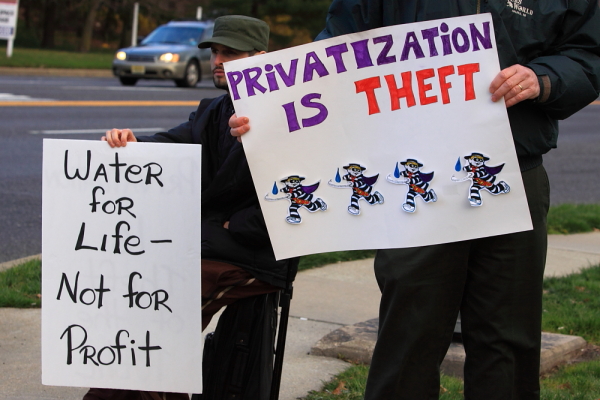
8 Ways Privatization Has Failed America

Privatization Failures

The Article: 8 Ways Privatization Has Failed America by Paul Buchheit in The Contributor.

The Text: Some of America’s leading news analysts are beginning to recognize the fallacy of the “free market.” Said Ted Koppel, “We are privatizing ourselves into one disaster after another.” Fareed Zakaria admitted, “I am a big fan of the free market…But precisely because it is so powerful, in places where it doesn’t work well, it can cause huge distortions.” They’re right. A little analysis reveals that privatization doesn’t seem to work in any of the areas vital to the American public.

Health Care

Our private health care system is by far the most expensive system in the developed world. Forty-two percent of sick Americans skipped doctor’s visits and/or medication purchases in 2011 because of excessive costs. The price of common surgeries is anywhere from three to ten times higher in the U.S. than in Great Britain, Canada, France, or Germany. Some of the documented tales: a $15,000 charge for lab tests for which a Medicare patient would have paid a few hundred dollars; an $8,000 special stress test for which Medicare would have paid $554; and a $60,000 gall bladder operation, which was covered for $2,000 under a private policy.

As the examples begin to make clear, Medicare is more cost-effective. According to the Council for Affordable Health Insurance, Medicare administrative costs are about one-third that of private health insurance. More importantly, our ageing population has been staying healthy. While as a nation we have a shorter life expectancy than almost all other developed countries, Americans covered by Medicare INCREASED their life expectancy by 3.5 years from the 1960s to the turn of the century.

Continue Reading

Email

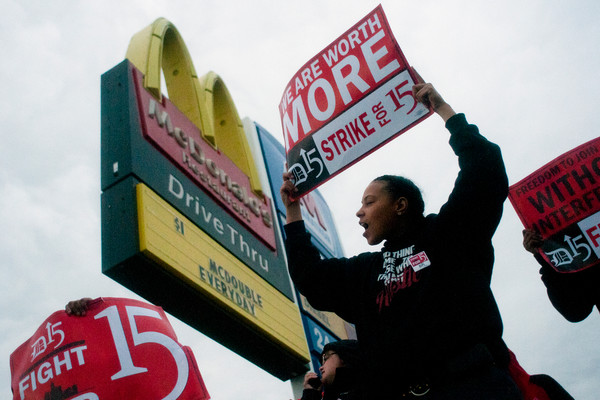
A Fast Food Worker Reveals What Low Wage Life Is Really Like

Fast Food Strike

The Article: I Work for Burger King at $7.40 an Hour — Here’s What It’s Like and Why Fast Food Workers Are on Strike by Claudette Wilson in Alternet.

The Text: Claudette Wilson is 20 and works two jobs in the fast food industry, one at Burger King and one at a pizza place. She is on her feet, sometimes for 12 hours a day, and makes $7.40 an hour. She agreed to share her experience for the Guardian’s A Day’s Work series because she wants people to understand why fast food workers have been striking for better wages.

Wilson participated in a protest in Detroit, Michigan last week.

1. What is your typical day like?

Everyday for me is different. I can tell you how a typical Saturday is like: first I wake up around 8am to go to work at Burger King from 10am to 6pm. After I get off of work from Burger King, I go to my second job at Jet’s Pizza from 6pm to midnight. After I get done with working, sometimes I hang with friends, sometimes I just go to sleep.

2. There’s been a lot of talk lately about people wanting work/life balance. Does your job provide that?

Continue Reading

Email

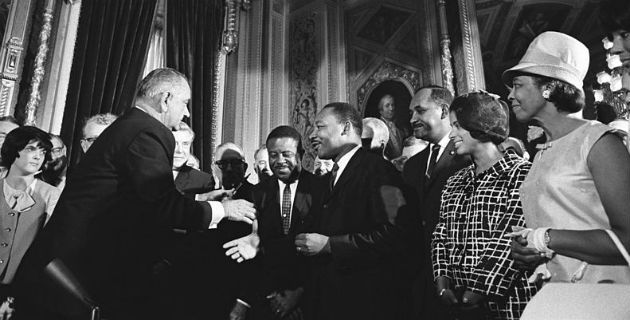
5 Terrible Acts Of Voter Discrimination The Voting Rights Act Prevented

LBJ MLK VRA 630

The Article: 5 Terrible Acts of Voter Discrimination the Voting Rights Act Prevented—But Won’t Anymore by Lauren Williams in Mother Jones.

The Text: President Lyndon Johnson signed the Voting Rights Act of 1965 into law 48 years ago today. But in June, the conservative justices on the Supreme Court struck down a major section of the law, freeing jurisdictions with a history of racial discrimination to change their voting laws without federal permission. For decades, Section 5 of the VRA required a number of jurisdictions, mostly in the South, to seek the feds’ approval—called preclearance, in legal parlance—before modifying voting rules. The Supreme Court’s decision gutted Section 5, paving the way for new discriminatory laws.

Since the high court ruling, North Carolina has passed what critics have called the worst voter ID law in the country, Texas pushed ahead with a voter ID law and redistricting plan that the VRA blocked last year, and Attorney General Eric Holder has vowed to continue to challenge discriminatory voting laws despite the Supreme Court ruling. Florida’s Republican governor, Rick Scott, announced this week that he would renew his efforts to purge “noncitizens” from the voter rolls, a messy, inaccurate practice that the Justice Department says violates the VRA and unfairly targets black and Latino voters.

Continue Reading

Email

When A Company Pays Low Wages, It’s A Choice–Not A Law

Cashier Customer

The Article: Sorry, It’s Not A ‘Law Of Capitalism’ That You Pay Your Employees As Little As Possible by Henry Blodget in Business Insider.

The Text: One of the big reasons the U.S. economy is so lousy is that big American companies are hoarding cash and “maximizing profits” instead of investing in their people and future projects.

This behavior is contributing to record income inequality in the country and starving the primary engine of U.S. economic growth — the vast American middle class — of purchasing power. (See charts below).

If average Americans don’t get paid living wages, they can’t spend much money buying products and services. And when average Americans can’t buy products and services, the companies that sell products and services to average Americans can’t grow. So the profit obsession of America’s big companies is, ironically, hurting their ability to accelerate revenue growth.

Continue Reading

Email

Hot On The Web