Author Archive

Bernie Sanders On What We Can Learn From Denmark
What We Can Learn From Denmark

The Article: What Can We Learn From Denmark? by Bernie Sanders in The Huffington Post.

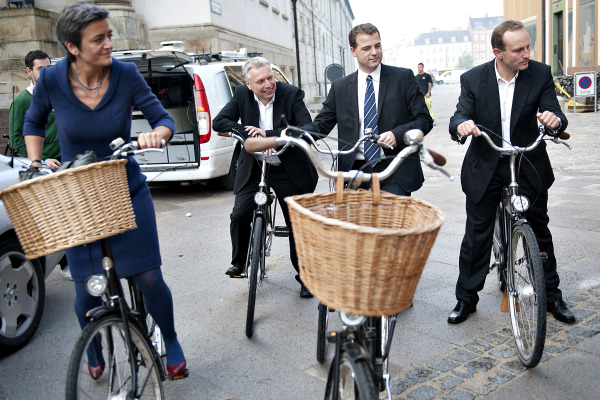
The Text: Danish Ambassador Peter Taksoe-Jensen spent a weekend in Vermont this month traveling with me to town meetings in Burlington, Brattleboro and Montpelier. Large crowds came out to learn about a social system very different from our own which provides extraordinary security and opportunity for the people of Denmark.

Today in the United States there is a massive amount of economic anxiety. Unemployment is much too high, wages and income are too low, millions of Americans are struggling to find affordable health care and the gap between the very rich and everyone else is growing wider.

While young working families search desperately for affordable child care, older Americans worry about how they can retire with dignity. Many of our people are physically exhausted as they work the longest hours of any industrialized country and have far less paid vacation time than other major countries.


Continue Reading

Email

“Right To Work”: The Most Dishonest Phrase In America

Right To Work

The Article: The Most Dishonest Words in American Politics: ‘Right to Work’ by Steven Wishnia in AlterNet.

The Text: ā€œRight to workā€ is the most dishonest phrase in American political discourse. It sounds like it’s defending people’s right to earn a living. But as used by its supporters, it means making it impossible for workers to form an effective union, couched in the language of ā€œfreedomā€ and ā€œchoice.ā€

Specifically, it means laws banning ā€œunion shops,ā€ in which everyone in a workplace has to join the union or pay a fee to cover the cost of union representation. Twenty-four states have such laws. All were in the South and West until last year, when Indiana and Michigan enacted them. Michigan’s law was rammed through the Republican-dominated legislature in a lame-duck session last December.

The Michigan law was ā€œpretty devastating for the labor movement,ā€ says Erin Johansson of American Rights at Work. It came in the state where the United Auto Workers’ six-week occupation of General Motors plants in Flint in 1937 won the victory that opened the doors for unions throughout American industry, the state whose union labor defined the working-class prosperity of World War II to the 1970s.

Continue Reading

Email

The Touch-Screen Generation

Touch Screen Generation

The Article: The Touch-Screen Generation by Hanna Rosin in The Atlantic.

The Text: On a chilly day last spring, a few dozen developers of children’s apps for phones and tablets gathered at an old beach resort in Monterey, California, to show off their games. One developer, a self-described ā€œvisionary for puzzlesā€ who looked like a skateboarder-recently-turned-dad, displayed a jacked-up, interactive game called Puzzingo, intended for toddlers and inspired by his own son’s desire to build and smash. Two 30?something women were eagerly seeking feedback for an app called Knock Knock Family, aimed at 1-to-4-year-olds. ā€œWe want to make sure it’s easy enough for babies to understand,ā€ one explained.

The gathering was organized by Warren Buckleitner, a longtime reviewer of interactive children’s media who likes to bring together developers, researchers, and interest groups—and often plenty of kids, some still in diapers. It went by the Harry Potter–ish name Dust or Magic, and was held in a drafty old stone-and-wood hall barely a mile from the sea, the kind of place where Bathilda Bagshot might retire after packing up her wand. Buckleitner spent the breaks testing whether his own remote-control helicopter could reach the hall’s second story, while various children who had come with their parents looked up in awe and delight. But mostly they looked down, at the iPads and other tablets displayed around the hall like so many open boxes of candy. I walked around and talked with developers, and several paraphrased a famous saying of Maria Montessori’s, a quote imported to ennoble a touch-screen age when very young kids, who once could be counted on only to chew on a square of aluminum, are now engaging with it in increasingly sophisticated ways: ā€œThe hands are the instruments of man’s intelligence.ā€

Continue Reading

Email

Chicago’s Losing Choice

Chicago

The Article: Chicago’s Choice: Closing 50 Schools But Spending $100 Million On Basketball Arena by in The Contributor.

The Text: As we wrote in March, the city of Chicago unveiled plans two months ago to close over 50 schools, mostly in the poorest areas.

Mayor Rahm Emanuel’s plan has sparked fierce protests, with thousands of protesters hitting the streets last weekend to oppose the school closures –arguing that they would put children at risk by having to travel further to overcrowded schools.

But while the city insists it must close these schools to close budget gaps, it has just announced that it will be dedicated as much as $100 million in public funds for the construction of a new basketball arena at DePaul University — which is about a third of the cost of the project.

Continue Reading

Email

Can Democrats Get A New Party, Too?

New Democratic Party

The Article: Can Democrats Get a New Party, Too? by Lawrence Lessig in The Atlantic.

The Text: It’s obvious to any sane Republican that the GOP needs to remake itself. The brand “rich, white, and male” may be fine for a fraternity (in 1953). It’s not so great for a political party today. If anything is certain about 2016, it is that the Republicans will survive only if the GOP becomes something more. Its followers, in other words, are about to get a new party.

But with Hillary Clinton seemingly poised to run for president and resume the Clinton dynasty’s reign, here’s the question Democrats need to ask: Can we get a new party too?

Our problem isn’t the Republicans’ — we’re not too exclusive. It’s the opposite: We are wildly too inclusive. The Democrats are indeed a rainbow coalition, courting every hue of American society. But the leaders of the party believe that at our core, there must be a dark shade of green. For at least 20 years, conventional Democratic wisdom has been that we can do nothing unless we give pride of place to large-dollar funders of Democratic campaigns. This money, most Democrats would concede, may well be evil, but it is a necessary evil. And the trick, we’ve been told again and again, is to pass as much policy as we can, subject to the constraints of raising big money.

Continue Reading

Email

Hot On The Web