Author Archive

The Austerity Agenda
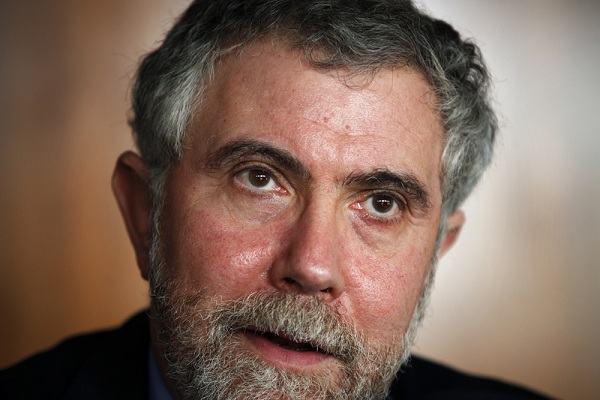
Paul Krugman Austerity Agenda

The Article: The 1 Percent’s Solution by Paul Krugman in The New York Times.

The Text: conomic debates rarely end with a T.K.O. But the great policy debate of recent years between Keynesians, who advocate sustaining and, indeed, increasing government spending in a depression, and austerians, who demand immediate spending cuts, comes close — at least in the world of ideas. At this point, the austerian position has imploded; not only have its predictions about the real world failed completely, but the academic research invoked to support that position has turned out to be riddled with errors, omissions and dubious statistics.

Yet two big questions remain. First, how did austerity doctrine become so influential in the first place? Second, will policy change at all now that crucial austerian claims have become fodder for late-night comics?

On the first question: the dominance of austerians in influential circles should disturb anyone who likes to believe that policy is based on, or even strongly influenced by, actual evidence. After all, the two main studies providing the alleged intellectual justification for austerity — Alberto Alesina and Silvia Ardagna on “expansionary austerity” and Carmen Reinhart and Kenneth Rogoff on the dangerous debt “threshold” at 90 percent of G.D.P. — faced withering criticism almost as soon as they came out.


Continue Reading

Email

In The US, We Lose Our Heads Over Terror But Not Daily Gun Deaths

Guns United States

The Article: Why does America lose its head over ‘terror’ but ignore its daily gun deaths? by Michael Cohen in The Guardian.

The Text: The thriving metropolis of Boston was turned into a ghost town on Friday. Nearly a million Bostonians were asked to stay in their homes – and willingly complied. Schools were closed; business shuttered; trains, subways and roads were empty; usually busy streets eerily resembled a post-apocalyptic movie set; even baseball games and cultural events were cancelled – all in response to a 19-year-old fugitive, who was on foot and clearly identified by the news media.

The actions allegedly committed by the Boston marathon bomber, Dzhokhar Tsarnaev and his brother, Tamerlan, were heinous. Four people dead and more than 100 wounded, some with shredded and amputated limbs.

But Londoners, who endured IRA terror for years, might be forgiven for thinking that America over-reacted just a tad to the goings-on in Boston. They’re right – and then some. What we saw was a collective freak-out like few that we’ve seen previously in the United States. It was yet another depressing reminder that more than 11 years after 9/11 Americans still allow themselves to be easily and willingly cowed by the “threat” of terrorism.

Continue Reading

Email

Matt Taibbi On The Biggest Financial Scandal Yet

Financial Markets

The Article: Everything Is Rigged: The Biggest Financial Scandal Yet by Matt Taibbi in Rolling Stone.

The Text: Conspiracy theorists of the world, believers in the hidden hands of the Rothschilds and the Masons and the Illuminati, we skeptics owe you an apology. You were right. The players may be a little different, but your basic premise is correct: The world is a rigged game. We found this out in recent months, when a series of related corruption stories spilled out of the financial sector, suggesting the world’s largest banks may be fixing the prices of, well, just about everything.

You may have heard of the Libor scandal, in which at least three – and perhaps as many as 16 – of the name-brand too-big-to-fail banks have been manipulating global interest rates, in the process messing around with the prices of upward of $500 trillion (that’s trillion, with a “t”) worth of financial instruments. When that sprawling con burst into public view last year, it was easily the biggest financial scandal in history – MIT professor Andrew Lo even said it “dwarfs by orders of magnitude any financial scam in the history of markets.”

That was bad enough, but now Libor may have a twin brother. Word has leaked out that the London-based firm ICAP, the world’s largest broker of interest-rate swaps, is being investigated by American authorities for behavior that sounds eerily reminiscent of the Libor mess. Regulators are looking into whether or not a small group of brokers at ICAP may have worked with up to 15 of the world’s largest banks to manipulate ISDAfix, a benchmark number used around the world to calculate the prices of interest-rate swaps.

Continue Reading

Email

Ralph Nader On The Bush Legacy

Bush Legacy

The Article: He Is Comfortable with Bush’s Inferno by Ralph Nader in Common Dreams.

The Text: George W. Bush is riding high. A megamillionaire, from the taxpayer-subsidized Texas Rangers company, he makes $150,000 to $200,000 per speech, receives a large presidential pension and support facilities and is about to dedicate the $500 million George W. Bush Presidential Library and Museum on April 25.

President Obama will be at the dedication, continuing to legitimize Mr. Bush, as he did from the outset by announcing in 2009 there would be no investigations or prosecutions of the Bush officials for their crimes.

In an interview with the New York Times, Mr. Bush continued to say he has no regrets about his Presidency. “I’m comfortable with what I did,” he said, “I’m comfortable with who I am.” He added, “Much of my presidency was defined by things that you didn’t necessarily want to have happen.”

Continue Reading

Email

The Jobless Trap

Jobless Trap

The Article: The Jobless Trap by Paul Krugman in The New York Times.

The Text: F.D.R. told us that the only thing we had to fear was fear itself. But when future historians look back at our monstrously failed response to economic depression, they probably won’t blame fear, per se. Instead, they’ll castigate our leaders for fearing the wrong things.

For the overriding fear driving economic policy has been debt hysteria, fear that unless we slash spending we’ll turn into Greece any day now. After all, haven’t economists proved that economic growth collapses once public debt exceeds 90 percent of G.D.P.?

Well, the famous red line on debt, it turns out, was an artifact of dubious statistics, reinforced by bad arithmetic. And America isn’t and can’t be Greece, because countries that borrow in their own currencies operate under very different rules from those that rely on someone else’s money. After years of repeated warnings that fiscal crisis is just around the corner, the U.S. government can still borrow at incredibly low interest rates.

Continue Reading

Email

Hot On The Web