Author Archive

Regarding The Democratic Farce

The Article: The Democratic Fraud and the Universalist Alternative by Samir Amin in the Monthly Review.

The Text:

1. The Democratic Fraud Challenges Us to Invent Tomorrow’s Democracy

Universal suffrage is a recent conquest, beginning with workers’ struggles in a few European countries (England, France, Holland, and Belgium) and then progressively extending throughout the world. Today, everywhere on the planet, it goes without saying that the demand for delegating supreme power to an honestly elected, multiparty assembly defines the democratic aspiration and guarantees its realization—or so it is claimed.

Marx himself put great hopes on such universal suffrage as a possible “peaceful path to socialism.” Yet, I have noted that on this score Marx’s expectations were refuted by history (cf. Marx et la dĂ©mocratie).

I think that the reason for the failure of electoral democracy to produce real change is not hard to find: all hitherto existing societies have been based on a dual system of exploitation of labor (in various forms) and of concentration of the state’s powers on behalf of the ruling class. This fundamental reality results in a relative “depoliticization/disacculturation” of very large segments of society. And this result, broadly designed and implemented to fulfill the systemic function expected of it, is simultaneously the condition for reproduction of the system without changes other than those it can control and absorb—the condition of its stability. What is called the “grass roots,” so to speak, signifies a country in deep slumber. Elections by universal suffrage under these conditions are guaranteed to produce a sure victory for conservatism, albeit sometimes a “reformist” conservatism.

This is why never in history has there been real change resulting from this mode of governance based on “consensus” (i.e. the absence of change). All changes tending toward real social transformation, even radical reforms, have resulted from struggles waged by what, in electoral terms, may appear to be “minorities.” Without the initiative of such minorities, the motive force of society, no change is possible. Such struggles, engaged in by such “minorities,” always end up—when the alternatives proposed are clearly and correctly defined—by carrying along (previously silent) majorities and may by universal suffrage receive ratification, which arrives after—never before—victory.

In our contemporary world “consensus” (its boundaries defined by universal suffrage) is more conservative than ever. In the centers of the world-system the consensus is pro-imperialist. Not in the sense that it implies hatred or contempt for the other peoples who are its victims, but in the everyday sense that the permanence of the flow of imperialist rent is accepted because that is the condition for overall social reproduction, the guarantor of its “opulence” in contrast to the poverty of the others. In the peripheries, the responses of peoples to the challenge (pauperization resulting from the process of capitalist/imperialist accumulation) is still muddled, in the sense that they are fated always to carry with them a dose of retrograde illusions of a return to a better past.

In these conditions, recourse to “elections” is always conceived by the dominant powers as the best possible way to rein in the movement, to end the possibility that the struggles become radicalized. In 1968 some said that “elections are for assholes,” and that view was not unconfirmed by the facts. An elected assembly, right away—as today in Tunisia and Egypt—serves only to put an end to “disorder,” to “restore stability.” To change everything so that nothing changes.

So should we give up on elections? Not at all. But how to bring together new, rich, inventive forms of democratization through which elections can be used in a way other than is conceived by the conservative forces? Such is the challenge.

The Democratic Farce’s Stage Scenery

This stage scenery was invented by the Founding Fathers of the United States, with the very clearly expressed intention of keeping electoral democracy from becoming an instrument that could be used by the people to call in question the social order based on private property (and slavery!).

With that in mind, their Constitution was based on (indirect) election of a president (a sort of “elective monarch”) holding in his hands some essential powers. Presidential election campaigns under these conditions naturally gravitate to “bipartisanism,” which tends progressively to become what it now is: the expression of a “single party.” Of course, ever since the end of the nineteenth century this has represented the interest of monopoly capital, addressing itself to “clienteles” that view themselves as having differing interests.

The democratic fraud then displays itself as offering “alternatives” (in this case, the Democrats and the Republicans) that cannot ever rise to the level required by a real alternative (offering the possibility of new, radically different, options). But without the presence of real alternative perspectives democracy is nonexistent. The farce is based on “consensus”(!) ideology, which excludes by definition serious conflicts between interests and between visions of the future. The invention of “party primaries” inviting the whole electorate (whether its components are said to be leftist or rightist!) to express its choices of candidates for the two false adversaries accentuates still further that deviation so annihilating for the meaning of elections.

Jean Monnet, a true anti-democrat is honored today in Brussels, where his intentions to copy the U.S. model were fully understood, as the founder of the “new European democracy.” Monnet deployed all his efforts, which were scrupulously implemented in the European Union, to deprive elected assemblies of their powers and transfer them to “committees of technocrats.”

Continue Reading

Email

How Bloomberg Says The Right Things For The Right People

The Article: Mike Bloomberg’s Marie Antoinette Moment by Matt Taibbi in Rolling Stone.

The Text: Last year I had a chance to see New York Mayor Mike Bloomberg up close at the Huffington Post’s “Game Changers” event. I was standing right behind the guy when he was introduced by Nora Ephron, and watched as the would-be third party powerhouse wowed the liberal crowd with one zinger after another.

He started off with a crack about Ephron, saying he had agreed to say something nice about her book, which he blithely noted he hadn’t read. Still, he knew the title, “I Remember Nothing,” which he said he’d “heard is also the title of a new book by Charlie Sheen.” (He pronounced Sheen like “Shine”).

From there he cracked that he was honored to be a “Game Changer,” although he was only the last-minute replacement for Snooki. (Zing!) Then he went into a riff about Halloween.

“Does everyone have their costume?” he asked. (This is the old “Did you hear this? Have you heard about this?” Jimmy-Vulmer-style standup routine). “I thought about going in a… dress,” he began. “But then I decided I would just go as the fiscally-conservative, pro-choice, anti-smoking, anti-trans-fat Jewish billionaire mayor of the World’s Greatest City.”

The crowd roared. Bloomberg smiled, looked up, extended his hands, and said, “Maybe that’s just too much of a stretch, I don’t know.”

Man, I thought. This guy is really sure of himself. If there is such a thing as infinite self-satisfaction, he was definitely approaching it that night.

And it wasn’t hard to see why. Bloomberg’s great triumph as a politician has been the way he’s been able to win over exactly the sort of crowd that was gathering at the HuffPost event that night. He is a billionaire Wall Street creature with an extreme deregulatory bent who has quietly advanced some nastily regressive police policies (most notably the notorious “stop-and-frisk” practice) but has won over upper-middle-class liberals with his stances on choice and gay marriage and other social issues.

Bloomberg’s main attraction as a politician has been his ability to stick closely to a holy trinity of basic PR principles: bang heavily on black crime, embrace social issues dear to white progressives, and in the remaining working hours give your pals on Wall Street (who can raise any money you need, if you somehow run out of your own) whatever they want.

He understands that as long as you keep muggers and pimps out of the prime shopping areas in the Upper West Side, and make sure to sound the right notes on abortion, stem-cell research, global warming, and the like, you can believably play the role of the wisecracking, good-guy-billionaire Belle of the Ball for the same crowd that twenty years ago would have been feting Ed Koch.

Anyway, I thought of all of this this morning, when I read about Bloomberg’s latest comments on Occupy Wall Street. I remembered how pleased Bloomberg looked with himself at the HuffPost ball last year when I read what he had to say about the anticorruption protesters now muddying his doorstep in Zuccotti Park:

Mayor Michael Bloomberg said this morning that if there is anyone to blame for the mortgage crisis that led the collapse of the financial industry, it’s not the “big banks,” but congress.

Speaking at a business breakfast in midtown featuring Bloomberg and two former New York City mayors, Bloomberg was asked what he thought of the Occupy Wall Street protesters.

“I hear your complaints,” Bloomberg said. “Some of them are totally unfounded. It was not the banks that created the mortgage crisis. It was, plain and simple, congress who forced everybody to go and give mortgages to people who were on the cusp. Now, I’m not saying I’m sure that was terrible policy, because a lot of those people who got homes still have them and they wouldn’t have gotten them without that.”

To me, this is Michael Bloomberg’s Marie Antoinette moment, his own personal “Let Them Eat Cake” line. This one series of comments allows us to see under his would-be hip centrist Halloween mask and look closely at the corrupt, arrogant aristocrat underneath.

Continue Reading

Email

The Rise Of American Oligarchy

The Article: Oligarchy, American Style by Paul Krugman in the New York Times.

The Text: Inequality is back in the news, largely thanks to Occupy Wall Street, but with an assist from the Congressional Budget Office. And you know what that means: It’s time to roll out the obfuscators!

Anyone who has tracked this issue over time knows what I mean. Whenever growing income disparities threaten to come into focus, a reliable set of defenders tries to bring back the blur. Think tanks put out reports claiming that inequality isn’t really rising, or that it doesn’t matter. Pundits try to put a more benign face on the phenomenon, claiming that it’s not really the wealthy few versus the rest, it’s the educated versus the less educated.

So what you need to know is that all of these claims are basically attempts to obscure the stark reality: We have a society in which money is increasingly concentrated in the hands of a few people, and in which that concentration of income and wealth threatens to make us a democracy in name only.

The budget office laid out some of that stark reality in a recent report, which documented a sharp decline in the share of total income going to lower- and middle-income Americans. We still like to think of ourselves as a middle-class country. But with the bottom 80 percent of households now receiving less than half of total income, that’s a vision increasingly at odds with reality.

In response, the usual suspects have rolled out some familiar arguments: the data are flawed (they aren’t); the rich are an ever-changing group (not so); and so on. The most popular argument right now seems, however, to be the claim that we may not be a middle-class society, but we’re still an upper-middle-class society, in which a broad class of highly educated workers, who have the skills to compete in the modern world, is doing very well.

It’s a nice story, and a lot less disturbing than the picture of a nation in which a much smaller group of rich people is becoming increasingly dominant. But it’s not true.

Workers with college degrees have indeed, on average, done better than workers without, and the gap has generally widened over time. But highly educated Americans have by no means been immune to income stagnation and growing economic insecurity. Wage gains for most college-educated workers have been unimpressive (and nonexistent since 2000), while even the well-educated can no longer count on getting jobs with good benefits. In particular, these days workers with a college degree but no further degrees are less likely to get workplace health coverage than workers with only a high school degree were in 1979.

So who is getting the big gains? A very small, wealthy minority.

The budget office report tells us that essentially all of the upward redistribution of income away from the bottom 80 percent has gone to the highest-income 1 percent of Americans. That is, the protesters who portray themselves as representing the interests of the 99 percent have it basically right, and the pundits solemnly assuring them that it’s really about education, not the gains of a small elite, have it completely wrong.

If anything, the protesters are setting the cutoff too low. The recent budget office report doesn’t look inside the top 1 percent, but an earlier report, which only went up to 2005, found that almost two-thirds of the rising share of the top percentile in income actually went to the top 0.1 percent — the richest thousandth of Americans, who saw their real incomes rise more than 400 percent over the period from 1979 to 2005.

Who’s in that top 0.1 percent? Are they heroic entrepreneurs creating jobs? No, for the most part, they’re corporate executives. Recent research shows that around 60 percent of the top 0.1 percent either are executives in nonfinancial companies or make their money in finance, i.e., Wall Street broadly defined. Add in lawyers and people in real estate, and we’re talking about more than 70 percent of the lucky one-thousandth.

But why does this growing concentration of income and wealth in a few hands matter? Part of the answer is that rising inequality has meant a nation in which most families don’t share fully in economic growth. Another part of the answer is that once you realize just how much richer the rich have become, the argument that higher taxes on high incomes should be part of any long-run budget deal becomes a lot more compelling.

The larger answer, however, is that extreme concentration of income is incompatible with real democracy. Can anyone seriously deny that our political system is being warped by the influence of big money, and that the warping is getting worse as the wealth of a few grows ever larger?

Some pundits are still trying to dismiss concerns about rising inequality as somehow foolish. But the truth is that the whole nature of our society is at stake.

Email

The American Spring

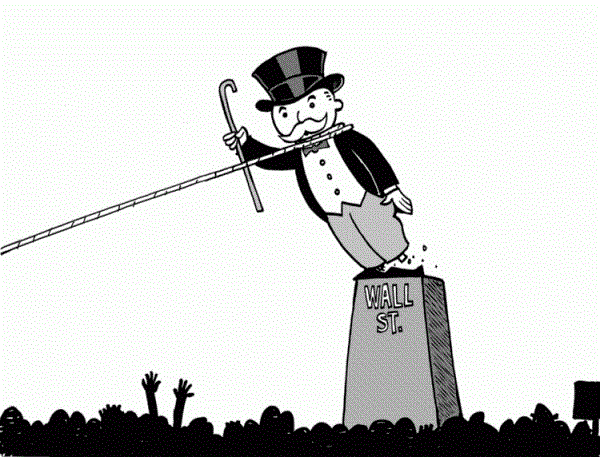
The American Spring Political Cartoon

Email

Lessons From The 21st Century Anti-War Movements

The Article: Heart-Attack Iraq: Lessons From an Antiwar Movement by Tom Hayden in the Nation.

The Text: On October 21, when President Obama announced that all American troops would be withdrawing from Iraq, I learned that I needed surgery on a blocked carotid artery, and soon. Ten years earlier, between the 9/11 attacks and the US invasion of Iraq, I was having quintuple bypass surgery. The Cedars-Sinai doctors even delayed the operation in case Los Angeles was struck that day.

For ten years, though, my heart kept its faithful beat. For 3,500 straight days and nights, I researched, wrote, spoke, taught and lobbied against the Iraq War. I tried to avoid pepper spray and being stomped, but for everything else, the beat was steady. When Obama made the withdrawal announcement last week, it was as if my heart was saying, Take me back to the repair shop. And so I will go once more, and will, I hope, come out battling against the wars and injustices of the next decade.

On Saturday, the day after Obama’s statement, my heart felt good as I introduced Representative Barbara Lee at a Los Angeles fundraiser. In the lightness of her mood I sensed a burden had been lifted from her heart as well.

Some of the hundred people in the room were baffled by the Obama withdrawal decision—understandably so, after a decade of several wars, a stolen election that led directly to Bush’s Iraq invasion, and now a Great Recession greatly worsened by trillions of tax dollars spent on Iraq, Afghanistan and Pakistan, instead of Wisconsin, Ohio and Pennsylvania. A certain jadedness has affected our consciousness after this very bad decade. Some people in the room didn’t believe Obama was actually going to pull out of Iraq. He would sneak in 5,000 manipulative mercenaries to take over from the last of the American troops. And what about those other wars? Wasn’t he worse than Bush? Yada yada yada, ad nauseam.

I think the American troops will leave Iraq. The Iraqi people, who are regaining their sovereignty, will welcome their departure. So, too, will the American people who made the peace necessary through ten years of struggle on many fronts, including the election of Barack Obama. Yes, the other wars will continue, corporate power will continue, global warming will continue, but the lessons of the campaign against the Iraq War may be helpful as we face these other challenges.

Ending the war in Iraq was not inevitable. Angered by 9/11, ignorantly indifferent to Muslim lives and arrogantly filled with superpower delusions, the American people could have backed an all-out and permanent invasion with 1 million troops and saturation bombing. The Iraqi people, liberated from Saddam Hussein, could have submitted to American dominance, or been conquered through internal divisions, instead of resisting.

But the feverish neocons and the myopic political establishment were deluded in two ways: they were blinded to the strength of militant Iraqi nationalism, and to the potential of a peace movement in the United States. Winning the war and ushering in the world of their dreams, they thought, would be a cakewalk.

Iraq became the focal point of many contradictions in the world: between Third World nationalism and Western imperial designs; between the capacity of the US/NATO forces and imperial overreach; between oil imperialism and sovereignty; and between budgeting for a Long War versus budgeting for American needs.

In their smugness, our would-be rulers thought we could be panicked into a permanent state of war. They underestimated our consciousness, including a healthy skepticism toward the claims of power, bred deeply in us since the 1960s. In their initial reports on the antiwar movement, both the New York Times and NPR were dismissive and dramatically understated the number of protesters who attended the first major demonstration, in Washington in October 2002, which brought 100,000 to the capital (both later apologized). Like the characters in JosĂ© Saramago’s book Blindness, they were unable to see the marchers before their eyes.

Continue Reading

Email

Hot On The Web