Author Archive

It Is Immoral To Cage Humans For Smoking Weed

Marijuana

The Article: It Is Immoral to Cage Humans for Smoking Marijuana by Conor Friedersdorf in The Atlantic.

The Text: Under the law in 48 states, here’s what can happen when an adult is thought to possess marijuana: Men with guns can go to his home, kick down his door, force him to lay face down on the floor, restrain him with handcuffs, drive him to a police station, and lock him in a cage. If he is then convicted of possessing marijuana, a judge can order that he be locked in a different cage, perhaps for years.

There are times when locking human beings in cages is morally defensible. If, for example, a person commits murder, rape, or assault, transgressing against the rights of others, then forcibly removing him from society is the most just course of action. In contrast, it is immoral to lock people in cages for possessing or ingesting a plant that is smoked by millions every year with no significant harm done, especially when the vast majority of any harm actually done is borne by the smoker.

That there are racial disparities in who is sent to prison on marijuana charges is an added injustice that deserves attention. But if blacks and whites were sent to prison on marijuana charges in equal proportion, jail for marijuana would still be immoral.


Continue Reading

Email

Isaac Asimov’s Eerily Accurate Predictions For 2014

Isaac Asimov

The Article: Isaac Asimov’s Predictions for 2014 Were Eerily Prescient. Except for the Internet. by Jerry A. Coyne in The New Republic.

The Text: Roughly 50 years ago, on August 16, 1964, science-fiction writer Isaac Asimov predicted in The New York Times what the world would be like fifty years hence. (He was inspired by the World’s Fair of 1964, to which my sister and I were taken by our parents.) It’s a longish piece, and concentrates on the problem of increasing population as well as on the ability of technology to deal with that pressure and to improve our lives.

I’ll highlight just three of his predictions, one mostly right, one partly right, and one wrong.

This is what he got mostly right:

In 2014, there is every likelihood that the world population will be 6,500,000,000 and the population of the United States will be 350,000,000. Boston-to-Washington, the most crowded area of its size on the earth, will have become a single city with a population of over 40,000,000.

Continue Reading

Email

9 Huge Government Conspiracies That Actually Happened

Conspiracy Theories

The Article: 9 Huge Government Conspiracies That Actually Happened by Christina Sterbenz in Business Insider.

The Text: We all know the conspiracy theories — the government’s plan for 911, the second gunman who shot JFK, the evolution of the elite from a race of blood-drinking, shape-shifting lizards.

But the people who spread these ideas usually can’t prove them.

As the years pass, however, secrets surface. Government documents become declassified. We now have evidence of certain elaborate government schemes right here in the U.S. of A.

1. The U.S. Department of the Treasury poisoned alcohol during Prohibition — and people died.

The 18th Amendment, which took effect in January 1920, banned the manufacture, sale, and transportation of alcohol — but not consumption. Despite the government’s efforts, alcoholism actually skyrocketed during the era.

Continue Reading

Email

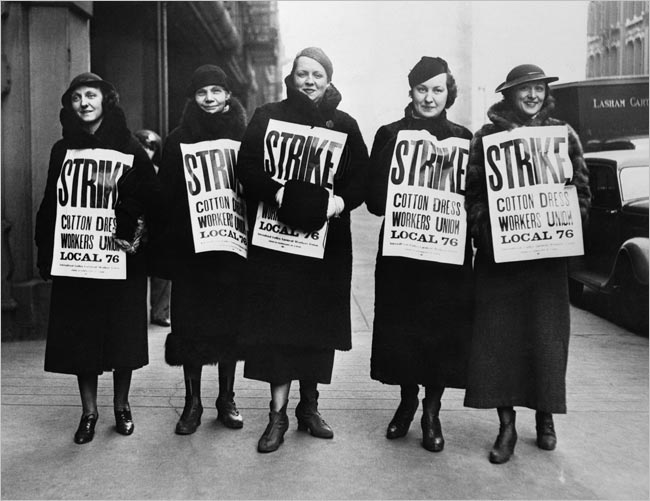
How Unions Destroy Their Own

Unions

The Article: How The Unions Destroy Their Own — As Viewed By A Life-Long Union Supporter by Rick Ungar in Forbes.

The Text: My connection to the union movement has deep roots—roots planted in my being while growing up in a northeastern Ohio steel town. It was a place and a time where the protections and earning opportunities made possible by the union resulted in an era of middle class creation and social advancement for the many blue collar workers that formed the very heart of Youngstown, Ohio.

Men and women who were willing to work hard on the day or night shift were spurred on by the knowledge that their union was also working hard to insure that the working class would earn not only enough money to care for their families, but would have enough left over at the end of the week to put some aside for the college tuition that would insure that their own kids would not have to spend their life in the steel mills.

While these union workers may have been toiling away in manual labor jobs that required more brawn than brain, they were anything but stupid—and their union leaders clearly understood this. So much was this the case that, to this day, I swear that I learned far, far more from the men and women I encountered working in the steel mills during my summer breaks from college than I ever learned inside a classroom.

Continue Reading

Email

We Are Creating Walmarts of Higher Education

Higher Education

The Article: ‘We Are Creating Walmarts of Higher Education’ by Timothy Pratt in The Atlantic.

The Text: Universities in South Dakota, Nebraska, and other states have cut the number of credits students need to graduate. A proposal in Florida would let online courses forgo the usual higher-education accreditation process. A California legislator introduced a measure that would have substituted online courses for some of the brick-and-mortar kind at public universities.

Some campuses of the University of North Carolina system are mulling getting rid of history, political science, and various others of more than 20 “low productive” programs. The University of Southern Maine may drop physics. And governors in Florida, North Carolina and Wisconsin have questioned whether taxpayers should continue subsidizing public universities for teaching the humanities.

Under pressure to turn out more students, more quickly and for less money, and to tie graduates’ skills to workforce needs, higher-education institutions and policy makers have been busy reducing the number of required credits, giving credit for life experience, and cutting some courses, while putting others online.

Continue Reading

Email

Hot On The Web